Arkansas Contractor License Requirements in 2026: Thresholds, Insurance, Bonds and Renewal
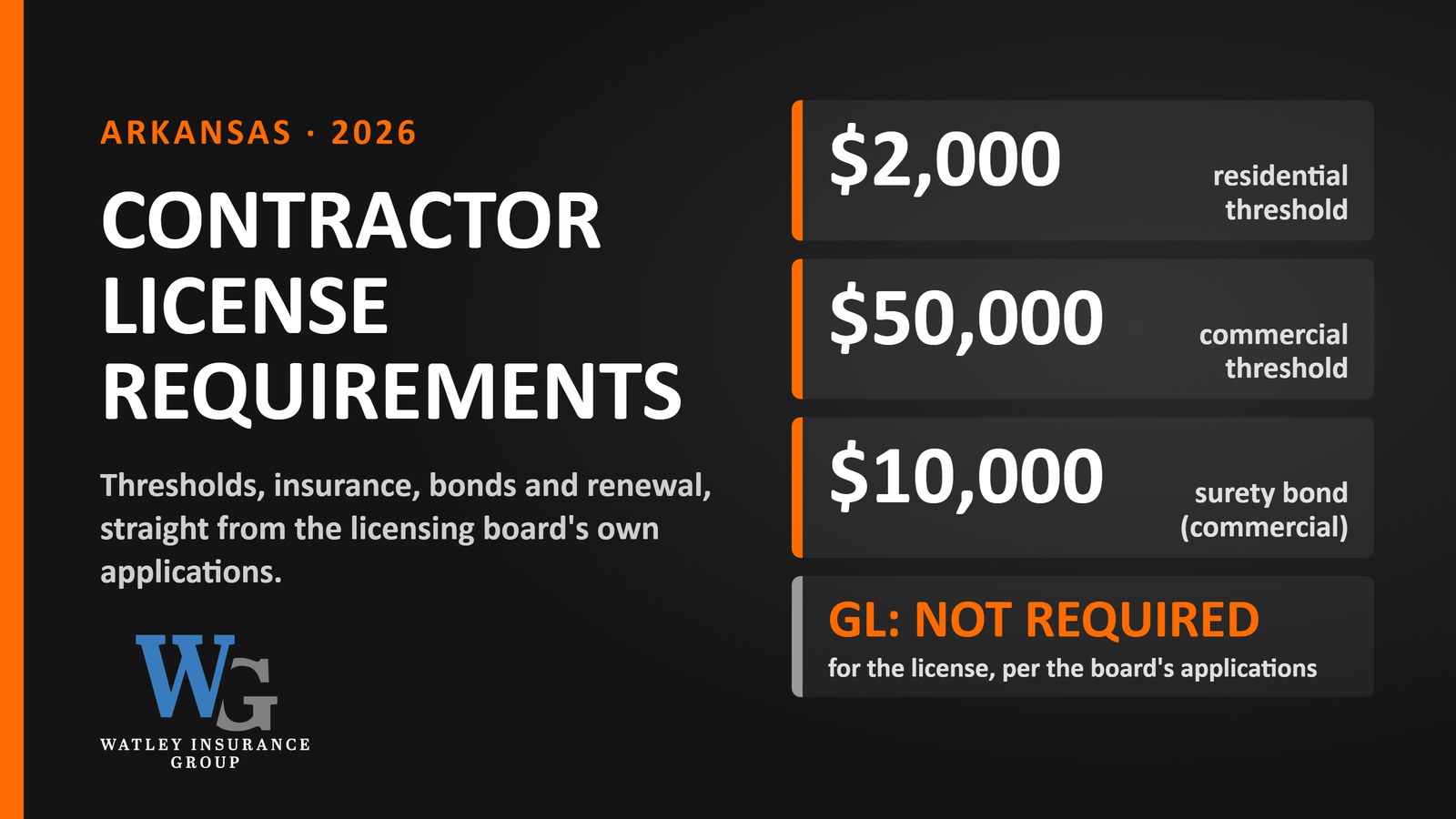
Quick answer: In Arkansas you need a contractor license for residential work over $2,000 and for commercial work of $50,000 or more, labor and materials included. The Arkansas Contractors Licensing Board does not require general liability insurance to issue or renew a standard contractor license. What it does ask for depends on the license: a certificate showing workers' compensation coverage if you have one or more employees, a $10,000 surety bond for commercial licenses and registered subcontractors, financial statements for most license types, and a renewal every year.
Key takeaways:
- The residential threshold is $2,000, and it is set by statute, not by board policy.
- Commercial means any project that is not a single-family residence. The commercial threshold is $50,000.
- The licensing board does not ask for general liability insurance. Your general contractor, your client or your contract usually will.
- The board asks for one insurance document: a workers' comp certificate, and only if you have employees.
What Are the Arkansas Contractor License Requirements in 2026?
Residential work over $2,000, including labor and materials, needs a license. Which one depends on the work, according to the board's license menu: a residential builder license to build a home, a residential remodeler license for major structural changes or additions, a home improvement license for specialty trades, or a residential roofing registration for roofing only. That $2,000 threshold is written into the statute: Ark. Code Ann. § 17-25-513(3)(A) exempts residential and home improvement work only when the cost "does not exceed two thousand dollars ($2,000)." Not $20,000, not $50,000.
The same section closes the obvious workaround. The exemption does not apply when one project is divided into separate contracts of less than $2,000 each (§ 17-25-513(3)(B)).
For licensing purposes, a single-family residence is a project of one to four units built for residential occupancy. Home improvement licenses come in two forms, according to the board's home improvement application: a Limited license for residential projects under $50,000, and an Unlimited license for projects of any size.
What Is the Commercial Contractor License Threshold in Arkansas?
A commercial license or registration is required when the cost of the contractor's work, labor and materials included, is $50,000 or more. The commercial law applies to prime contractors and subcontractors alike.
The commercial law covers all improvements and structures except single-family residences (Ark. Code Ann. § 17-25-101(c), as summarized in the board's home improvement application). A project of five or more units is multi-family housing and counts as commercial.
Since August 4, 2025, a Restricted commercial license covers projects under $1,500,000. Act 235 of 2025 raised that limit from $750,000. An Unrestricted license covers projects of any size. The new limit is posted on the board's News page and its Renew a License page. Some board forms, including the 10/2026 commercial application, still print the old number. A commercial license also lets you do residential work in the same classification.
Does Arkansas Require General Liability Insurance for Contractors?
Not for the license. The Arkansas Contractors Licensing Board does not require general liability insurance to issue or renew a standard commercial or residential contractor license. Neither the board's commercial application nor its home improvement application asks for it.
Published sources disagree, which is why the board's own application is the document to read. You can be fully licensed in Arkansas, in good standing with the state, and carry no general liability coverage at all. That is a compliance answer, not a coverage answer. The claim that puts a contractor out of business is usually a liability claim, and the license does nothing to pay it.
What Insurance Does the Arkansas Contractors Board Actually Require?
One document. If you have one or more employees, you submit a current certificate of insurance showing workers' compensation coverage, and the board's commercial application (August 2025 edition) says to list the Arkansas Contractors Licensing Board as the certificate holder. The board is at 4100 Richards Road, North Little Rock, AR 72117. The home improvement application applies the same rule to residential builders and Unlimited home improvement contractors; Limited home improvement contractors do not have to show it to obtain a license.
No employees, no certificate required by the board. The board's home improvement application notes that under Ark. Code Ann. § 11-9-102, generally all contractors with at least one employee are required to have workers' compensation coverage, enforced by the Workers' Compensation Commission. Ask your agent which applies to you.
Is a Contractor Surety Bond the Same as Insurance?
No. Commercial contractors and registered subcontractors must file a $10,000 surety bond with the board to have a valid license (Ark. Code Ann. §§ 17-25-401 and 17-25-404). The bond has to carry the principal's company name and EIN exactly as registered with the Secretary of State, and the board's application warns that any other name could be a violation.
The bond is payable to the State of Arkansas and is conditioned on your complying with the state's tax laws, the unemployment law and the Workers' Compensation Law (§ 17-25-404(b)). It backs your obligations to the State; it does not protect you. If a claim is paid on it, the surety generally expects you to pay it back. Insurance is the product that protects you, and having a bond tells you nothing about whether you have it.
Why Do Websites Disagree About Arkansas Contractor Insurance?
Two honest mistakes. The first is mixing up what the state requires with what the job requires. The board will license you without general liability insurance; a general contractor or commercial client will often not let you on site without it. The contract requirement sometimes gets written up as a licensing requirement.
The second is that other Arkansas boards do require liability coverage for their own trades. Licensed elevator contractors must carry general liability of at least $1,000,000 for injury or death and $500,000 for property damage (Ark. Code Ann. § 20-24-108). Asbestos abatement contractors licensed by the Division of Environmental Quality must show liability insurance in the form and amount the division requires (Ark. Code Ann. § 20-27-1006). Those are different boards with different rules.
Do Arkansas Roofers Need a Home Improvement License?
Not if roofing is all you do. The board's renewal page dates the change to January 1, 2022: residential roofing now takes a Residential Roofing Registration with the Residential Committee instead of a home improvement roofing license. The registration is only for roofers. If you do other residential work as well, such as siding or gutters, the board says to keep your home improvement license for that work.
If you added a trade this year, confirm your license or registration still covers the work you actually do.
When Do You Renew an Arkansas Contractor License?
Every year. You complete the renewal application and pay the fee online, then email or fax the rest to the board, because the portal will not take uploads:
- Commercial licenses: a current financial statement from a CPA (Reviewed or Audited for an Unrestricted license; Compiled is accepted for a Restricted license) or a bond in lieu of the financial statement, plus a current workers' comp certificate if you have employees. The board's application lists a $50,000 net worth requirement for the Building classification and $5,000 for a specialty, half of it in cash.
- Residential builders and Unlimited home improvement licenses: a current balance sheet showing positive net worth, plus a current workers' comp certificate if you have employees.
The license expiration date follows the date of the financial statement, so the paperwork clock never stops. The usual miss is simple: the policy is active, but the certificate the board has on file is last year's. Put your license renewal month and your policy renewal month on the same calendar. They are often different, and the gap between them is where certificates go stale.
What Should You Do Next?
- Check your thresholds before you bid: over $2,000 residential, $50,000 or more commercial.
- Read the board's application for your license type. It settles what the state requires.
- Pull your certificate and check the holder line and the dates.
- Separate licensing from coverage. Ask what your contracts require, then decide what to carry.
We collected the Arkansas coverage gaps and licensing points that catch contractors most often in our free Arkansas contractor guide. Working across state lines? Compare the Texas contractor license and insurance requirements and the Louisiana contractor insurance requirements.
Watley Insurance Group is licensed in Arkansas, Louisiana, Texas, Oklahoma, Tennessee, Georgia, Alabama and Mississippi.
Want your coverage and your license file reviewed together? Book a free insurance review: https://calendar.app.google/VAXw1WFmRwkG2zjS7
Licensing rules change. Confirm your own situation with the Arkansas Contractors Licensing Board. This article is general information, not legal or licensing advice, and not a coverage determination. Information verified October 18 and 19, 2026 against the board's own applications and the Arkansas Code.
Disclaimer: This article is for educational purposes only and does not constitute legal, regulatory, or professional insurance advice. Coverage requirements and options vary by state and individual circumstance. Please consult with a licensed insurance professional before making any coverage decisions.
Have Questions?
Speak with a Licensed Agent
Our team is ready to help Louisiana residents and businesses find the right coverage. No obligation, no pressure.