Why Was Your Certificate of Insurance Rejected?
Quick answer: a certificate of insurance is evidence of coverage, not a grant of coverage. It can only report what is actually on the policy behind it. When a correct certificate gets rejected, it is almost always because the thing being asked for — an additional insured endorsement, completed operations coverage, a waiver of subrogation, primary and non-contributory status, or the exact legal entity name — was never put on the policy. Re-issuing the certificate fixes none of that.
Key takeaways:
- A certificate is a snapshot with a date on it. It grants nothing, changes nothing, and does not update itself when the policy changes.
- Certificate holder and additional insured are completely different things. One gets sent the paper; the other has rights under the policy — and that one requires an endorsement the carrier actually has to issue.
- The four most common rejection causes are all policy-level, not certificate-level: ongoing vs completed operations, waiver of subrogation, primary and non-contributory, and the exact legal entity.
- The fix is never "send the certificate again." Send your agent the insurance section of the contract — the actual pages — before you sign.
Two things are happening at once in this market. Carriers are getting more restrictive about what they will endorse onto a policy, and general contractors are getting stricter about what their compliance portals will accept. Those two things collide on one piece of paper: your certificate of insurance. This is the third consecutive topic where the paperwork, not the coverage, turns out to be the failure point — and this time the paperwork itself is the subject.
What Is a Certificate of Insurance, Really?
A certificate of insurance is evidence that a policy existed on the day the certificate was issued. That is the whole job. It does not grant coverage to anybody, it does not change the policy, and it does not add anything to it — the form itself says as much in the small print nobody reads.
The consequence people miss: a certificate is a snapshot with a date on it. If something changes on the policy the month after the certificate went out, the certificate does not know that. It is still sitting in somebody's file saying what was true in March.
Certificate Holder vs Additional Insured: What's the Difference?
This is the single most common reason a certificate comes back.
Being listed in the certificate holder box means you get sent the paper. That is it. That is what the box does.
Being an additional insured means you have rights under the policy. Those are two entirely different things, and one of them requires the carrier to actually issue an endorsement against the policy. Typing somebody's name into a box on a certificate does not make them an additional insured — it makes them a person who received a document.
Any general contractor running a real compliance review will catch that immediately. That is exactly how a certificate that looks completely correct gets kicked back: the information on it is accurate, it just is not reporting the thing that was asked for, because the thing that was asked for was never put on the policy.
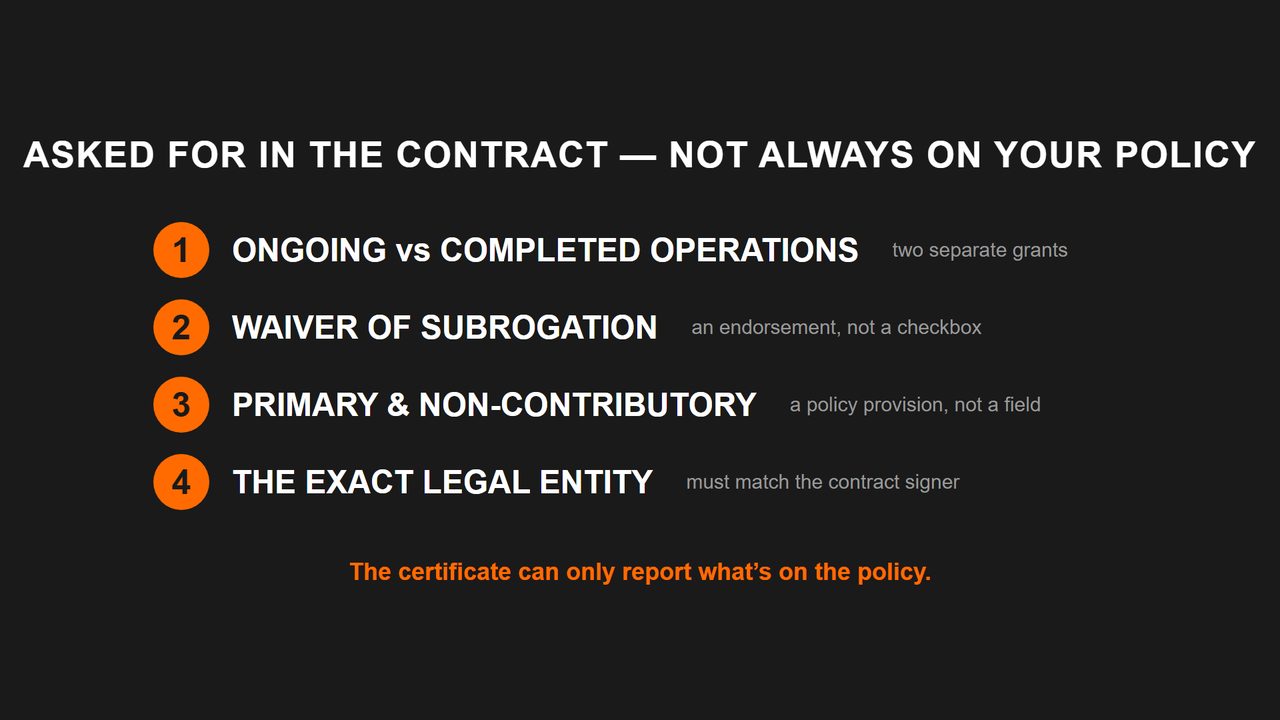
The Four Things Contracts Ask For That May Not Be on Your Policy
- Additional insured — ongoing operations vs completed operations. Two separate grants. Ongoing covers you while the work is happening; completed operations covers what happens after you have left the job. A contract that requires completed operations matched with an endorsement that only covers ongoing is a real gap — and it is the one that bites years later, when somebody has a problem with work you finished and forgot about.
- Waiver of subrogation. A policy endorsement, not a checkbox on a certificate.
- Primary and non-contributory. A policy provision, not a certificate field.
- The exact legal entity. The name on the policy has to be the entity that signs the contract. A DBA, an LLC you stopped using two years ago, or a personal name where the company should be — any of those will fail a compliance review.
The pattern across all four is the same: the certificate can only report what is on the policy. If it is not on the policy, no amount of re-issuing the certificate will fix anything.
Why "Send It Again" Costs You a Week
Here is where most contractors go wrong. The certificate gets rejected, so they call the agent and ask him to send it again. Nothing changes — because the document was never the problem.
Send your agent the insurance section of the contract instead. Not a description of it, not a text saying "they want a million in coverage" — the actual pages. A good agent reads that section and tells you three things: what is already on your policy, what needs an endorsement added, and what your carrier will not do at all.
That third category is real. Carriers decline endorsement requests — it happens. Finding that out before you have promised it in a contract is a completely different conversation than finding out after.
And plainly, because a lot of contractors take a rejected certificate personally: this is normal right now. Requirements have gotten stricter across the board. Being asked for something your policy does not have does not mean your agent messed up, and it does not mean you did anything wrong. It means the contract asked for something and nobody checked the policy against it yet.
What to Do This Week
- Pull your most recent certificate and look at the named insured. Is it the exact legal entity that signs your contracts?
- On your biggest current job, find the insurance section of the contract. Look for three phrases: completed operations, waiver of subrogation, primary and non-contributory.
- Send that section to your agent and ask a specific question: which of these is actually endorsed on my policy today?
Frequently Asked Questions
Why does the GC keep rejecting my certificate of insurance?
Almost always because something the contract requires is not actually on the policy — most commonly additional insured status (or the completed-operations half of it), a waiver of subrogation, primary and non-contributory wording, or a legal entity name that does not match the contracting party. The certificate can only report what the policy says, so re-issuing it changes nothing.
Does being a certificate holder make me an additional insured?
No. The certificate holder box only controls who gets sent the certificate. Additional insured status comes from an endorsement issued against the policy itself. They are unrelated, and confusing them is the most common cause of rejected certificates.
Does a certificate of insurance expire?
A certificate reflects the policy as of its issue date and typically shows the policy period. It does not update itself — if the policy changes or cancels after issuance, the certificate in the file does not know. That is why GCs ask for fresh certificates at renewal.
What should I send my insurance agent when a contract has insurance requirements?
The insurance section of the contract itself — the actual pages. Your agent can then tell you what is already on the policy, what needs an endorsement, and what the carrier will not do, before you sign.
I put together a free contractor risk toolkit that covers all of this in writing: watleyinsurancegroup.com/toolkit/contractor-risk. And if you want your certificate and your contract looked at together — which is really the only way to know whether one matches the other — book a time here.
This article is general information, not legal or coverage advice. Policy terms, endorsements, and carrier appetite vary. Read your own policy and your own contract.
Disclaimer: This article is for educational purposes only and does not constitute legal, regulatory, or professional insurance advice. Coverage requirements and options vary by state and individual circumstance. Please consult with a licensed insurance professional before making any coverage decisions.
Have Questions?
Speak with a Licensed Agent
Our team is ready to help Louisiana residents and businesses find the right coverage. No obligation, no pressure.