Why Did My Bar's Liability Insurance Go Up? Liquor Liability Explained
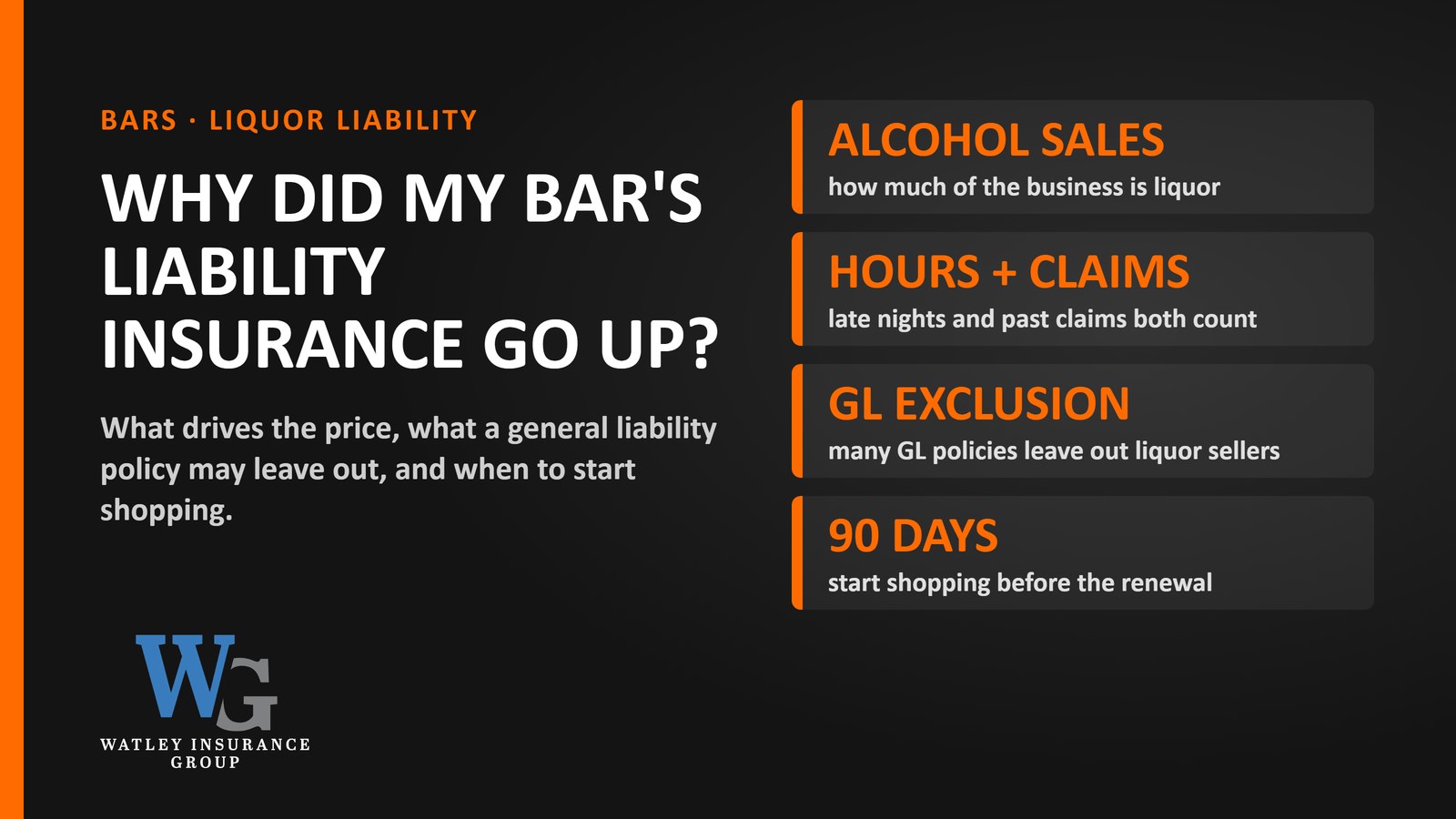
Quick answer: Bar and restaurant liability insurance usually goes up because you sell alcohol. Underwriters commonly price liquor liability on how much of your business is alcohol, your hours and entertainment, your claims history, and the liquor laws and court decisions in your state. You can't control the market, but you can start shopping early, clean up your records, and confirm that liquor liability is actually on your policy.
Key takeaways:
- Liquor liability is priced on your exposure and your own claims history, and on the legal environment in your state.
- Many general liability policies exclude liquor claims for businesses that sell or serve alcohol, so a bar commonly needs separate liquor liability coverage.
- Whether you need liquor liability to hold a liquor license depends on your state and sometimes your city.
- BYOB is not automatically covered or automatically excluded. It depends on your policy wording.
- Start shopping your renewal about 90 days out, not two weeks before it's due.
Why Is Liquor Liability Insurance Getting So Expensive?
In October, a New York City bar owner told Bloomberg that his liability insurance premium at one of his bars went up fivefold in four years (Insurance Journal, October 14, 2026). That is one bar in New York, not the South, and his number tells you nothing about yours. But the question behind it is one bar and restaurant owners in every state we write are asking right now.
The pricing factors themselves are not a secret. Liquor liability premiums are based on the exposure and the bar's own loss history, and the Insurance Services Office (ISO) assigns each state a liquor liability hazard grade based on its dram shop laws and court decisions (Big I Virtual University). In practice, underwriters commonly look at:
- Alcohol as a share of sales. A bar that is mostly liquor reads differently than a restaurant where drinks are a side line.
- Hours. Late-night service is commonly treated as more risk.
- Entertainment. Live music, dancing and pool tables can bring surcharges.
- Claims history. Past liquor claims follow you from carrier to carrier.
- The legal environment. Dram shop laws (the laws that let an injured person sue the business that served the drinks) and how courts apply them.
What Does Liquor Liability Insurance Actually Cover?
In plain English, liquor liability covers claims that your business served alcohol to someone who then hurt somebody. The classic case is a customer who was over-served, drove away and caused a wreck. When that happens, the injured person's attorney commonly names everyone who might pay, and the place that served the drinks is near the top of that list.
A liquor liability policy is built to defend you against that kind of claim and to pay covered damages. What it covers, and what it leaves out, is in the wording of your policy, so read it with your agent. Our liquor liability page walks through the basics.
Does General Liability Cover a Bar or Restaurant That Serves Alcohol?
Often not for the alcohol part. The standard commercial general liability (GL) form carries a liquor liability exclusion, and it applies when your business is "in the business of manufacturing, distributing, selling, serving or furnishing alcoholic beverages" (IRMI). A bar or a restaurant that sells drinks is in that business.
That is why a bar commonly carries a separate liquor liability policy or a liquor liability endorsement (an add-on to another policy) next to its GL. Your general liability policy still matters for the slip and fall in the parking lot. It just may not answer the drunk-driving claim.
Do I Need Liquor Liability Insurance to Get a Liquor License in My State?
It depends on the state, the license type and sometimes the city. Owners in Alabama, Arkansas, Georgia, Louisiana, Mississippi, Oklahoma, Tennessee and Texas all ask us this, and the answers are not the same.
In Alabama, for example, the ABC Board's rules require a retail licensee to show liquor liability (dram shop) coverage before the license is issued or renewed (Alabama Administrative Code 20-X-5-.14). Other states handle it differently, and some cities add requirements of their own. Before you assume anything, check with your state's alcohol licensing agency:
- Alabama: Alcoholic Beverage Control Board
- Arkansas: Alcoholic Beverage Control
- Georgia: Department of Revenue, Alcohol and Tobacco
- Louisiana: Office of Alcohol and Tobacco Control
- Mississippi: Department of Revenue, Alcoholic Beverage Control
- Oklahoma: ABLE Commission
- Tennessee: Alcoholic Beverage Commission
- Texas: Alcoholic Beverage Commission
Is a BYOB Restaurant Covered if a Customer Brings Their Own Alcohol?
It depends on your policy wording, your endorsements and your state. When ISO revised its general liability program in 2013, it said that allowing customers to bring their own alcohol is not, by itself, being in the business of serving alcohol (Claims Journal). But insurers can add endorsements that change that. If you charge a corkage fee, or your staff opens and pours the bottles, ask your agent how your policy treats it.
It also helps to know the difference between host liquor and liquor liability. Host liquor liability is coverage for alcohol you serve but don't sell, like at a company party. It is commonly part of a general liability policy, and it is not built for a bar. For one-off events, see our special event insurance page.
When Should I Start Shopping My Restaurant Insurance Renewal?
Start about 90 days before your renewal date. Underwriters need time, and a bar submission takes more than a quote form. A simple timeline:
- 90 days out: pull your loss runs, your sales split between food and alcohol, your hours, and any entertainment or security details.
- 60 days out: get your submission to market. Note any server training your staff has completed.
- 30 days out: compare the quotes on coverage, not just price. Confirm liquor liability is included and the limits match what your lease, your landlord or your license requires.
Two weeks before the due date leaves you with few options and little room to fix anything.
Will Tort Reform Lower My Liquor Liability Premium?
Maybe in time, but don't build your renewal around it. Liquor liability rates reflect each state's dram shop laws and how courts apply them. When a law changes, it can take years of claims before the change shows up in what carriers charge. Budget for the market you are renewing in today, and treat any relief as a bonus.
Frequently Asked Questions
Does general liability cover alcohol-related claims?
Often not for businesses that sell or serve alcohol. Many policies exclude it, so look for a liquor liability policy or endorsement.
Is liquor liability required in Texas, Louisiana, or Georgia?
It depends on the state, the license type and sometimes the city. Check with your state's alcohol licensing agency (listed above) and your agent before you assume.
Does liquor liability cover my bartender getting hurt?
No. Liquor liability answers claims from the people you served and the people they hurt. Employee injuries generally go through workers' comp.
What is host liquor liability?
Coverage for alcohol you serve but don't sell, like at a company event. It is commonly part of a general liability policy, and it isn't designed for a bar.
How early should I shop my restaurant insurance renewal?
Start about 90 days out. Underwriters need time, and waiting until two weeks before it's due leaves few options.
What Should You Do Next?
If you want a second set of eyes on your renewal, bring your current policy and your loss runs and we will go through them with you.
Book a free insurance review: https://calendar.app.google/VAXw1WFmRwkG2zjS7
Liquor laws, license rules and policy wording vary by state, by city and by insurer. This is general information, not legal or coverage advice. Read your own policy.
Disclaimer: This article is for educational purposes only and does not constitute legal, regulatory, or professional insurance advice. Coverage requirements and options vary by state and individual circumstance. Please consult with a licensed insurance professional before making any coverage decisions.
Have Questions?
Speak with a Licensed Agent
Our team is ready to help Louisiana residents and businesses find the right coverage. No obligation, no pressure.