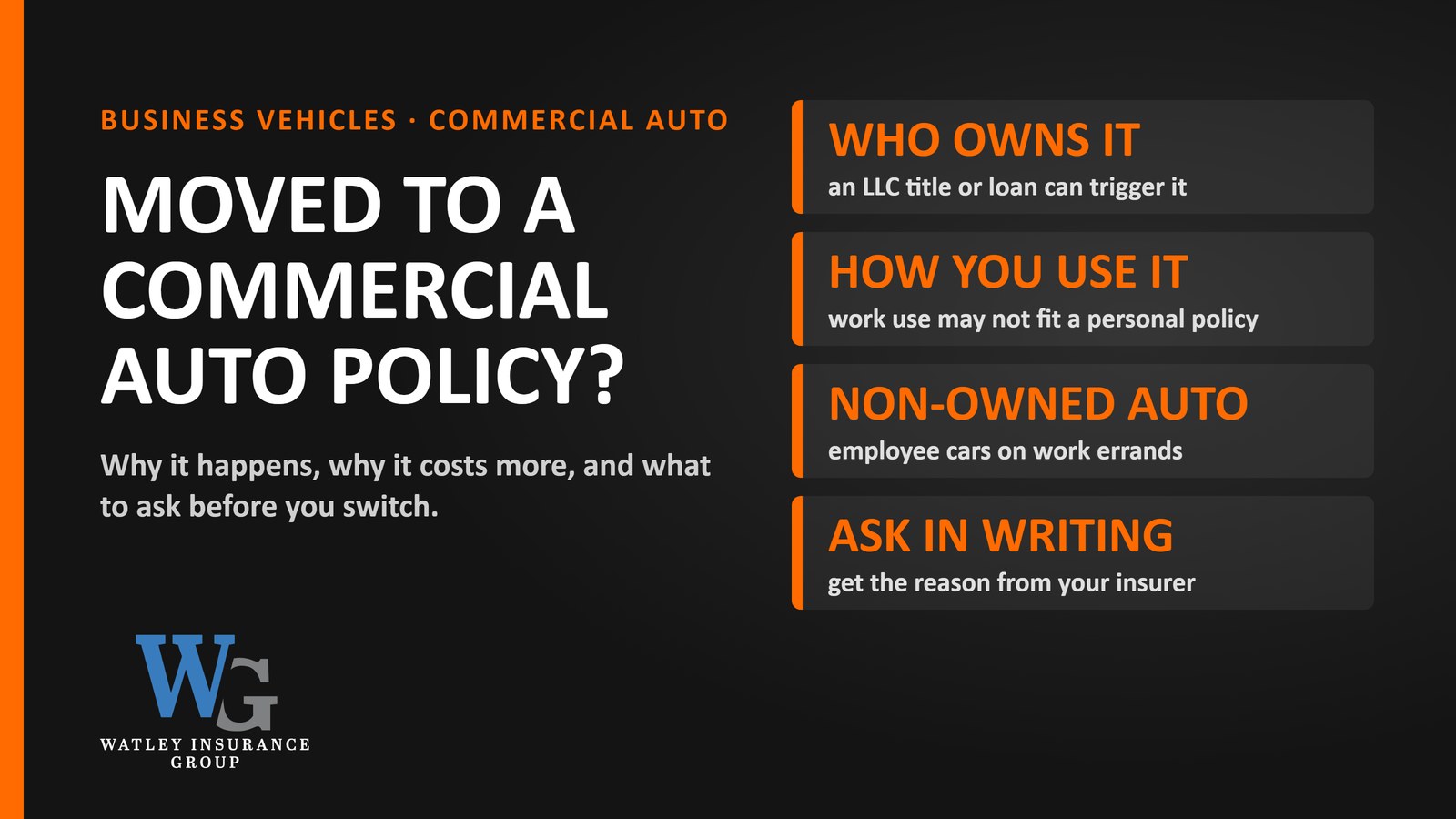
Why Is My Business Vehicle Being Moved to a Commercial Auto Policy?
Quick answer: It usually comes down to who owns the vehicle and how you use it. If your LLC or corporation owns it, finances it or pays for it, or you use it mainly for work, a personal auto policy may not fit, and your insurer may move it to commercial auto. Commercial auto commonly costs more, but a claim fight over a vehicle on the wrong policy can cost far more than the premium difference.
Key takeaways:
- Personal auto policies are generally written for vehicles owned by individuals and used for personal driving.
- A vehicle owned by a business, or used mainly for business, commonly belongs on a commercial auto policy. Carriers handle the details differently.
- Commercial auto commonly costs more because business vehicles generally carry more risk: more driving, more drivers and bigger lawsuits.
- Telling your insurer a work vehicle is for personal use can cause claim problems.
- Hired and non-owned auto covers your business when an employee drives their own car on a work errand.
Can I Put a Company-Owned Vehicle on a Personal Auto Policy?
Often, no. It's a question small business owners keep asking online, and the usual version goes like this: you form an LLC, the truck gets titled or financed in the company's name, the business makes the payments, and at renewal your insurer says the truck can't stay on your personal policy.
There's a reason for that. Personal auto policies are built for vehicles owned by individuals. The Insurance Information Institute puts it bluntly: if a business owns the vehicle, there is no coverage under a personal auto policy, and if a vehicle is used mainly for business, there likely isn't either (Triple-I).
Titling and ownership rules still vary by carrier. Some have their own ways of handling a vehicle titled to a small LLC, so ask yours how it treats a business-owned vehicle before you buy or retitle one, not after.
Why Does Commercial Auto Cost More Than Personal Auto?
The sticker shock is real. The reasons are mostly about risk:
- More driving. Work vehicles commonly rack up more miles, in more places, on a schedule.
- More drivers. Employees behind the wheel mean more people whose records count.
- Heavier vehicles and higher limits. Trucks, vans and trailers do more damage, and business contracts often require higher liability limits than a family car would carry.
- Bigger lawsuits. Commercial auto is one of the lines of insurance most affected by "social inflation," the rise in claim costs driven by very large jury verdicts and litigation trends (NAIC).
None of that makes a specific quote fair or unfair. It explains why the two policies are priced on different math.
Is My Insurance Company Moving Me to Commercial Auto Just to Charge More?
Not always. Insurers commonly move a vehicle when something on the file changes: the title or registration shows a business name, the loan is in the company's name, the vehicle carries business signage, or the way you described its use no longer fits a personal policy.
Ask your insurer for the reason in writing. That tells you what changed, whether the information is right, and whether there is anything you can correct before the change takes effect.
What Happens if I Tell My Insurer a Work Vehicle Is for Personal Use?
Misstating how a vehicle is used can create claim problems. Depending on your state and your policy, an insurer may be able to deny a claim, rescind or cancel the policy, or decline to renew it. No one can promise how a particular claim would go. What we can say is that the claim is the worst possible moment to find out the vehicle was on the wrong policy.
If the way you use a vehicle has changed, tell your agent. It is far easier to fix the policy than to argue about it after a wreck.
Who Pays if an Employee Wrecks Their Own Car on a Work Errand?
Usually, the employee's own auto policy pays first. But the injured person may also come after your business, and your employee's personal policy won't defend your company. That's the gap hired and non-owned auto coverage fills.
Hired and non-owned auto (HNOA) covers your business's liability when it uses vehicles it doesn't own: rentals, borrowed vehicles and employees' personal cars on business errands. It sits behind the employee's personal policy, and it does not pay for damage to the employee's car (Big I Virtual University). If your employees run to the supply house, make deposits or visit clients in their own cars, ask about it.
What Should I Ask Before Switching to a Commercial Auto Policy?
Before you sign, get clear answers on:
- Who is listed as a driver, and what happens when someone new drives.
- How far you drive and where, since radius and mileage commonly affect the price.
- What limits your contracts require. Leases, general contractors and brokers often set their own minimums. Confirm every limit against your actual contract.
- Whether hired and non-owned auto is included or needs to be added.
- What your state requires. Contractors, NEMT operators and garages in Alabama, Arkansas, Georgia, Louisiana, Mississippi, Oklahoma, Tennessee and Texas all deal with this, and state minimum limits and filing rules differ.
If you run medical transport, start with our NEMT insurance guide. If you work on customer vehicles, see does garage insurance cover customer cars. Our commercial auto page covers the basics.
Frequently Asked Questions
Do I need commercial auto if my LLC owns the truck?
Often, yes. Many carriers want business-owned vehicles on a commercial policy. Ask your agent how your carrier handles it.
Is commercial auto required in Texas or Oklahoma?
Minimum limits and filing rules depend on the state and on what you do, for example NEMT or hauling. Verify with your agent before you assume.
What is hired and non-owned auto insurance?
Coverage for your business's liability when it uses vehicles it doesn't own, like an employee's car on a supply run.
Can I keep my family cars and work trucks with the same agent?
Yes. Reviewing your personal auto and commercial auto together shows you the full cost and where the gaps are.
Why does commercial auto cost more than personal auto?
Business vehicles generally carry more risk: more driving, more drivers and bigger lawsuits.
What Should You Do Next?
If your insurer just told you a vehicle has to move, bring the letter and your current policy and we will go through it with you.
Book a free insurance review: https://calendar.app.google/VAXw1WFmRwkG2zjS7
Auto insurance rules, minimum limits and carrier guidelines vary by state and by insurer. This is general information, not legal or coverage advice. Read your own policy.
Disclaimer: This article is for educational purposes only and does not constitute legal, regulatory, or professional insurance advice. Coverage requirements and options vary by state and individual circumstance. Please consult with a licensed insurance professional before making any coverage decisions.
Have Questions?
Speak with a Licensed Agent
Our team is ready to help Louisiana residents and businesses find the right coverage. No obligation, no pressure.