Why Can't a New NEMT Company Get Insurance? What Underwriters Want From a New Business
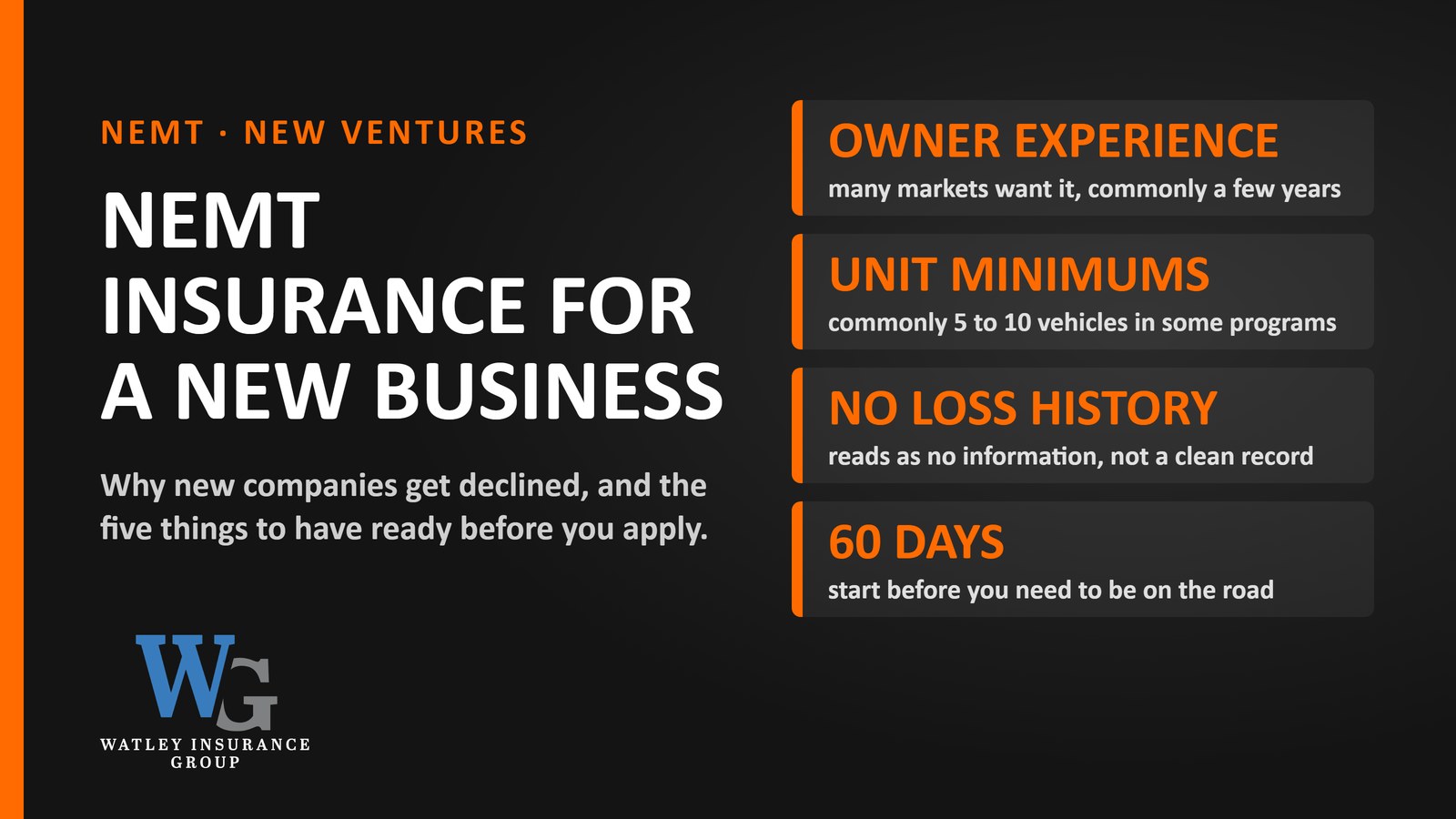
Quick answer: A new NEMT company often struggles to get insurance because part of the market will not write a new venture at all. Many NEMT insurance markets want the owner to have real experience in medical transport, some commercial auto programs carry minimum fleet sizes that one or two vans do not meet, and a company with no loss history gives an underwriter no information to price. It goes faster when you have five things ready and start about 60 days before you need to be on the road.
Key takeaways:
- The vans and broker credentialing are often the easy part. For a new venture, coverage is commonly the hard part.
- Many markets want the owner to have medical transport experience, commonly a few years, and some ask for a bio or resume.
- Some commercial auto markets carry unit minimums, commonly in the five to ten vehicle range.
- No claims history reads as no information, which is a big part of why new ventures often land in specialty markets.
- Price matters, but the real test is whether the policy carries what your broker contract requires.
Why Can't a New NEMT Company Get Insurance?
Most people starting a non-emergency medical transport company expect the hard part to be the vehicles or getting credentialed with a broker. For a lot of new operators, the hard part turns out to be insurance. Price is part of that, but the bigger surprise usually comes first: whether anybody will write the account at all. Part of the insurance market can decline a new company simply for being new, before price is ever discussed.
Underwriters build and protect their NEMT programs that way, and it has little to do with the quality of your business plan. The sections below walk through the reasons new ventures get declined, what a real submission looks like, and how to get ready.
Do NEMT Owners Need Experience to Get Insurance?
Often, yes. Many NEMT markets want the owner or principal to have real experience in medical transport, commonly a few years of it. A license or a certification does not replace it. What they want is experience actually doing the work, even if that experience came from working for someone else.
Some markets go further and ask for a bio or a resume on the owner, the way a lender would. That means a new company can have the vans, the drivers and the money lined up and still be told no because of the owner's background. If you are starting out, ask your agent which markets will consider a new venture. They exist, and what each one asks for varies by market, by state and by year.
If you worked in medical transport before you opened your own company, document it now: where you worked, for how long and what you did.
Why Do Insurance Companies Decline Small NEMT Fleets?
Some commercial auto markets carry a unit minimum, commonly somewhere in the five to ten vehicle range. If you are starting with one or two vans, you can be below the floor for part of the market before an underwriter ever looks at your file. Those programs are built that way, and because the minimum is rarely explained up front, the decline can feel like a personal rejection.
Ask your agent how many markets will even look at a fleet your size. The answer tells you what kind of search you are in for, and whether your timeline is realistic.
What Do You Need for an NEMT Insurance Submission?
A real NEMT submission is much more than a quote form. A full submission commonly includes:
- ACORD applications
- motor vehicle reports on every driver
- an NEMT-specific application
- a vehicle schedule with VINs
- your loss history (for a new venture, often none)
It also helps to know the difference between an indication and a quote. A preliminary indication is a rough estimate built on very little information. The actual underwriting starts after you say yes to that number, and that is usually when the full document list shows up. Ask which one you are looking at before you plan around it. Our free NEMT insurance guide puts the broker-side requirements in writing.
Does No Claims History Help or Hurt a New NEMT Company?
New operators often assume a clean record is an advantage. To an underwriter, no claims history means no information. An underwriter pricing a risk with no information commonly has to assume the middle of the range, or worse. That is a big part of why new ventures often end up in specialty markets paying specialty prices.
None of that is a penalty. A new company simply has not given the market anything to work with yet. Keep every loss run from your first policy forward, because underwriters commonly ask for several years of them later. Around three years in, reshop the account. That is when your history starts working for you.
Why Is NEMT Insurance So Expensive for a New Company?
Put the risk factors together and the price makes more sense. You are moving medically vulnerable passengers. A lot of what goes wrong in NEMT happens at the curb, during loading and unloading, rather than on the road. You are running high mileage, and as a new company you have no loss history. The price reflects that uncertainty. It is not a verdict on your business, and it often comes down once you have history.
Budget for the first-year number, not the number a friend quoted you from their fourth year of operating. To an underwriter, those are different businesses. Premiums vary by market, by state, by vehicle type and by history, so another operator's number tells you very little about yours.
Should You Buy the Cheapest NEMT Insurance Quote?
Price is a real factor, and nobody should pretend otherwise. But the cheapest quote and a compliant policy are two different tests. The question is whether the policy carries what your broker contract actually requires: the limits, the additional insured endorsement and the specific coverages the contract lists. Confirm every limit against your actual contract.
Price alone does not tell you whether a policy will pass credentialing. A policy that fails credentialing can cost more than the premium difference, because you cannot run trips while you fix it. Put the quote and the broker contract side by side before you sign either one. Our NEMT broker credentialing page lists what brokers commonly require and the certificate errors we see most. If you are already credentialed and the trips have slowed down, read why an NEMT broker stops sending trips.
How Do You Get NEMT Insurance as a New Business?
Have five things ready before you start:
- The owner's experience, documented.
- A vehicle schedule with VIN numbers.
- Motor vehicle reports pulled on every driver.
- The broker contract itself, not the recruiter summary.
- A realistic expectation about year-one pricing.
Then give it time. Start about 60 days before you need to be on the road, not two weeks. For a new venture this is rarely a same-week process. If you are still working through credentialing for the first time, start with our breakdown of what insurance NEMT companies need to get credentialed.
What Should You Do Next?
If you want somebody to go through it with you, bring your broker contract and we will read it together.
Book a free coverage review: https://calendar.app.google/VAXw1WFmRwkG2zjS7
Carrier appetite and broker requirements vary by market, by state and by year. This is general information, not legal or coverage advice. Read your own contract.
Disclaimer: This article is for educational purposes only and does not constitute legal, regulatory, or professional insurance advice. Coverage requirements and options vary by state and individual circumstance. Please consult with a licensed insurance professional before making any coverage decisions.
Have Questions?
Speak with a Licensed Agent
Our team is ready to help Louisiana residents and businesses find the right coverage. No obligation, no pressure.