What Does Primary and Non-Contributory Mean in a Subcontract? Here's What You Agreed To
Quick answer: In a subcontract, primary and non-contributory means two things. Primary means your policy pays first. Non-contributory means your policy can't ask the other party's policy, usually the general contractor's, to chip in. If you signed it, you made a promise about whose insurance responds to a claim and whose loss history takes the hit. That promise only holds if your policy actually carries the endorsement, and a certificate saying so doesn't make it true.
Key takeaways:
- Primary means your policy pays first. Non-contributory means your policy can't ask the other party's policy to chip in.
- If somebody gets hurt on the GC's job and the claim lands on your policy, it is your loss history that takes the hit.
- A promise in a contract isn't coverage. The endorsement has to be on your policy.
- A certificate only shows what is on the policy. A checked box doesn't fix a missing endorsement.
- Loss payee is about property, not liability. It does a different job than additional insured.
- Some endorsements cost extra money, so price them before you bid.
What Does Primary and Non-Contributory Mean in a Subcontract?
Your contract says primary and non-contributory, and you signed it. Here's what you actually agreed to.
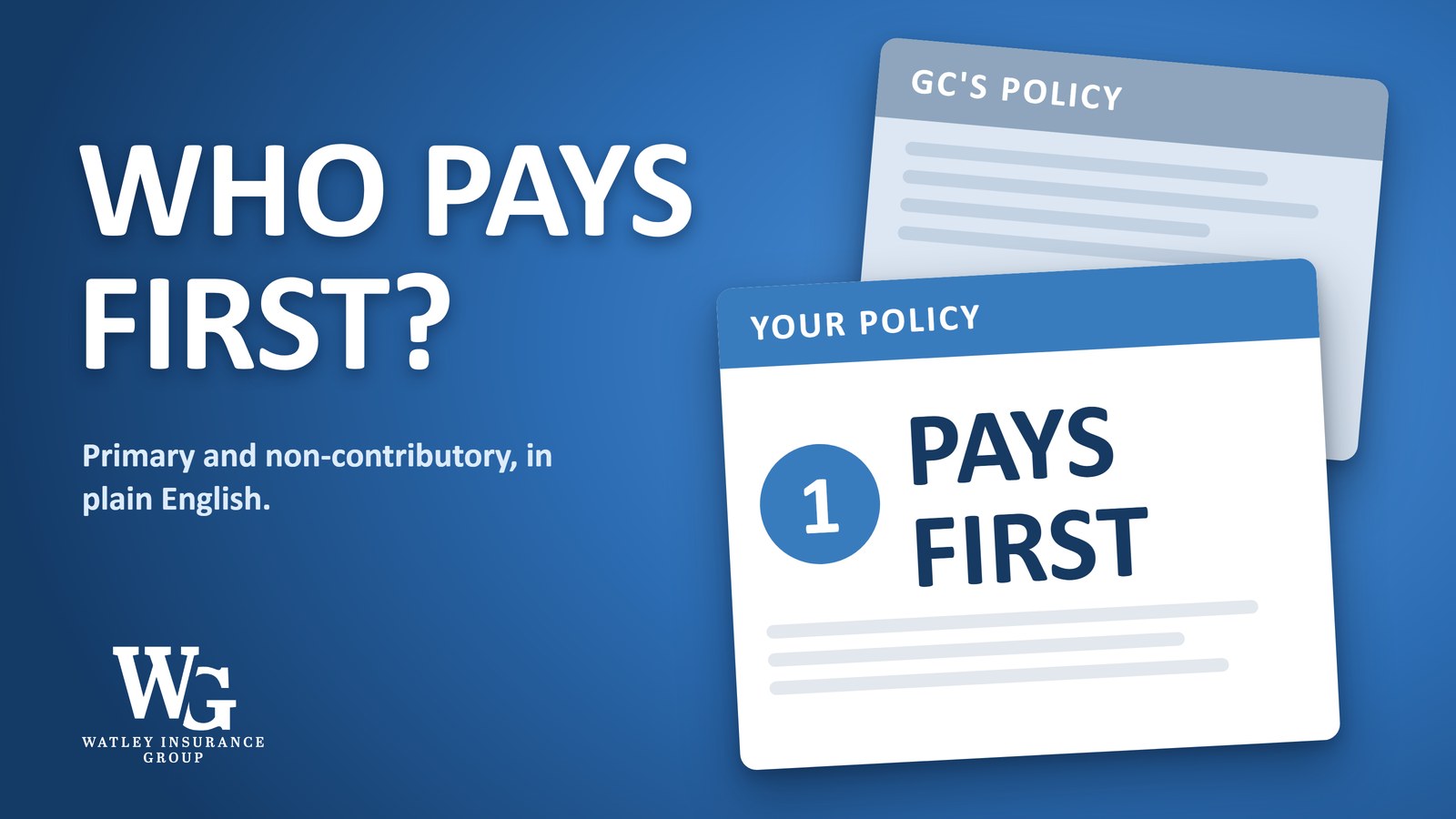
Primary means your policy pays first. When a claim comes in that your policy covers for the general contractor, your insurance responds before theirs does. Non-contributory means your policy can't turn around and ask their policy to chip in. When two policies cover the same claim, they commonly share it. With this language, yours goes first and can't ask theirs to share.
On many policies this is not automatic. It is commonly added by an endorsement, meaning an add-on to the policy, that changes how your policy treats the other party's insurance. Some contractor policies build it in for anyone you agreed to cover in a written contract, and some don't, which is exactly why you check instead of assuming.
Find the phrase in your last subcontract. It usually sits in the insurance section, right next to the additional insured requirement. If it is there and you signed, you made this promise.
Whose Insurance Pays First When Somebody Gets Hurt on the GC's Job?
Somebody gets hurt on the general contractor's job, and the claim is tied to your work. If you signed primary and non-contributory and your additional insured endorsement applies to that claim, your policy pays first, not theirs. That's the promise you made.
And your loss history takes the hit. A claim paid under your policy commonly shows up on your loss runs, even when the lawsuit named the GC and not you. At renewal, underwriters commonly review those loss runs, and a claim paid on the GC's behalf is still a claim on your account.
Many general contractors require the phrase as a condition of the job, so signing it is often part of getting the work. Know whose claim lands on your record before you sign, not after.
What Happens When Your Contract Promises Coverage Your Policy Doesn't Have?
Now flip it around. The contract says it, and the policy does not. You agreed to it in the contract, and your policy doesn't say it. Here's your problem.
A promise in a contract isn't coverage. The subcontract is an agreement between you and the general contractor. Your policy is an agreement between you and your insurance company, and it only does what it says. If the contract requires primary and non-contributory and your policy doesn't carry the endorsement, the coverage you promised may not be there when a claim comes in, and the GC may look to you for what you promised.
Your policy needs the endorsement, meaning the add-on. It has to be in there. So ask your agent one plain question: is it on the policy, or just on the certificate? We covered the bigger pattern behind this in why contracts, not policies, are where most contractors get caught.
Does a Certificate of Insurance Prove Primary and Non-Contributory?
No. The certificate says primary and non-contributory. That doesn't make it true.
A certificate only shows what's on the policy. It reports coverage; it doesn't create any. A box checked on the form, or a line typed into the description section, doesn't fix a missing endorsement. If the endorsement isn't on the policy, the certificate is describing coverage the policy doesn't have.
Ask for the endorsement, the language in the actual policy, and not just the certificate of insurance. If a general contractor has ever kicked a certificate back to you, our breakdown of why a certificate of insurance gets rejected walks through the most common reasons, including the difference between a certificate holder and an additional insured.
Why Do Additional Insured, Primary and Non-Contributory, and Waiver of Subrogation Come Together?
In many subcontracts these three phrases come as a set, and each one does a different job:
- Additional insured puts the GC on your policy. Here is what additional insured status actually means and why the endorsement matters more than the certificate.
- Primary and non-contributory means yours pays first and can't ask theirs to chip in.
- Waiver of subrogation means your insurer can't go after the GC to get money back after it pays a claim. Here is what you give up when you sign a waiver of subrogation.
Read together, they describe one arrangement. The GC is covered under your policy, your policy goes first, and your insurer gives up the right to recover from them. Each one is commonly its own endorsement, so having one of them on your policy doesn't mean you have the other two.
Three phrases, one phone call to your agent.
What Is the Difference Between Loss Payee and Additional Insured?
You rented a guy's equipment, and now he wants to be loss payee. What does that mean? If his gear gets damaged, the claim check can go straight to him.
That's about property, not liability. Loss payee protects the owner's interest in the equipment itself. It commonly sits on the part of your insurance that covers equipment you own, rent or borrow, often called inland marine or contractor's equipment coverage, and not on your general liability policy.
Additional insured is a different job. It is about liability: protection for someone else when a claim says your work hurt somebody or damaged their property. A rental agreement may ask for loss payee, additional insured, or both. Don't mix them up, and don't assume that because one is on your policy, the other one is too.
Who Pays for the Endorsements the GC Requires?
The GC wants it, your carrier charges for it, so who pays? Some endorsements cost extra money, and what is already included varies by policy and by carrier. If you find that out after you signed, the cost comes out of the margin you already committed to.
So price them before you bid. Put the insurance requirements in your bid math the same way you would price materials or a piece of equipment. We walked through that order of operations in why you should price insurance into a bid before you submit it.
What Should You Check Before You Sign the Next Subcontract?
Before you sign the next subcontract, find the insurance page and look for four phrases:
- Additional insured
- Primary and non-contributory
- Waiver of subrogation
- Loss payee
Match each one to your policy. For every phrase you find, the question is the same: is it on the policy as an endorsement, or only on the certificate? If one is missing, find out before you sign whether it can be added and what it costs, so it lands in your bid instead of your margin.
Four phrases, one check.
What Should You Do Next?
Send me the insurance page of your next subcontract, and we will run the four-phrase check against your policy together.
Book a free coverage review: https://calendar.app.google/VAXw1WFmRwkG2zjS7
Endorsement wording and contract requirements vary by carrier, by state and by job. This is general information, not legal or coverage advice. Read your own policy and your own contract.
Disclaimer: This article is for educational purposes only and does not constitute legal, regulatory, or professional insurance advice. Coverage requirements and options vary by state and individual circumstance. Please consult with a licensed insurance professional before making any coverage decisions.
Have Questions?
Speak with a Licensed Agent
Our team is ready to help Louisiana residents and businesses find the right coverage. No obligation, no pressure.