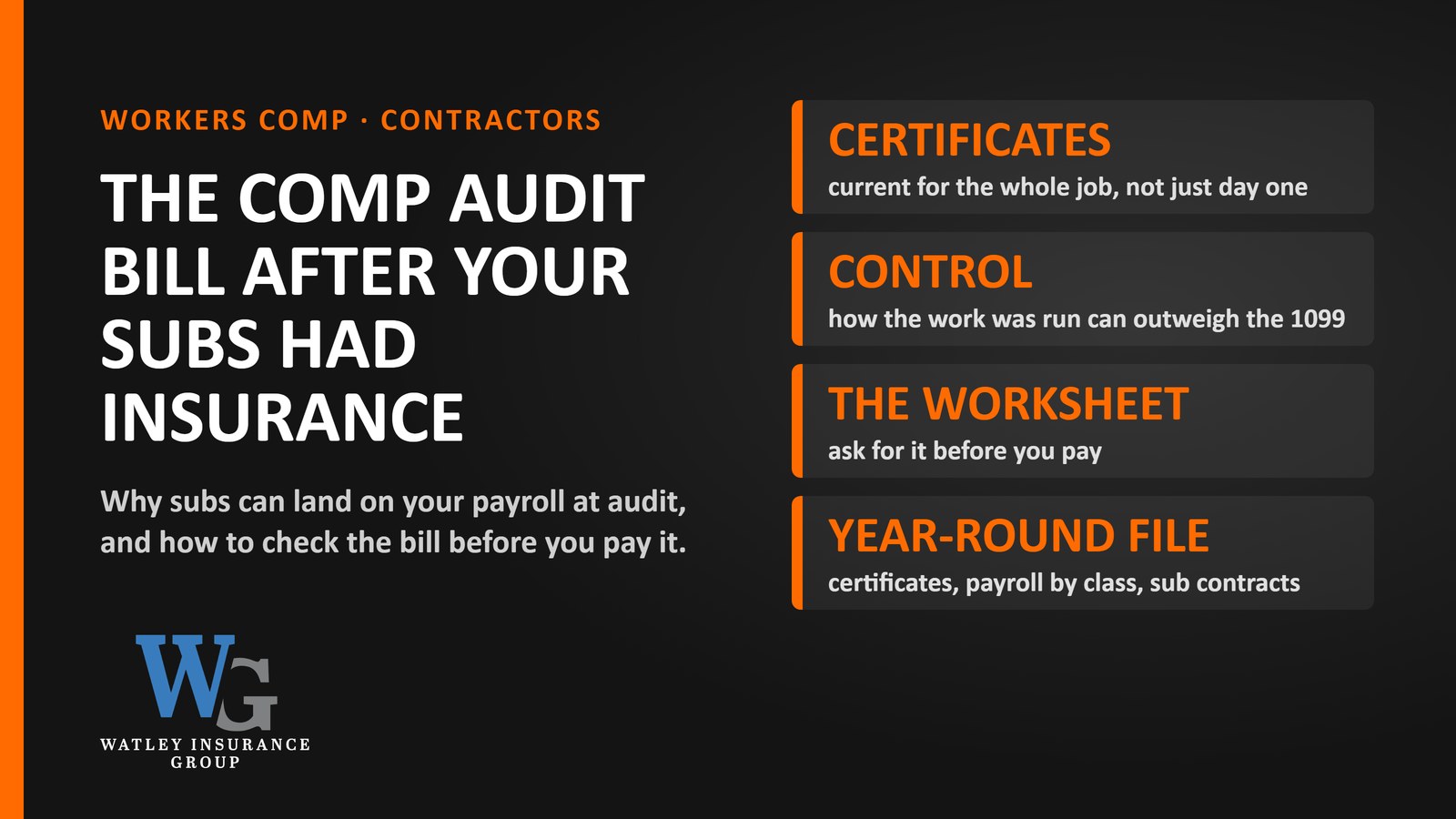
Why Did I Get a Workers Comp Audit Bill When My Subs Had Insurance?
Quick answer: A workers comp audit checks who actually worked for you and whether they were covered the whole time. A certificate of insurance helps, but if a sub's coverage lapsed during the job, or you can't prove it existed, the auditor can charge you for that sub's work. Separately, an auditor or a state agency can treat a "sub" as your employee depending on how the work was controlled. Don't just pay the bill. Ask for the audit worksheet, check it, and dispute the mistakes.
Key takeaways:
- The audit compares the payroll you estimated at the start of the policy to what you actually paid, including what you paid subs.
- A sub's certificate only helps if it shows coverage for the whole time the sub worked for you.
- A 1099 does not settle whether someone is a subcontractor. How the work was controlled can matter more.
- You can dispute an audit. Start with your carrier, and pay the part you don't dispute.
- The easiest audit is the one you prepare for all year.
What Is a Workers Comp Premium Audit?
When your workers comp policy starts, the premium is based on an estimate of your payroll. After the policy period ends, the carrier audits your records and recalculates the premium on what you actually paid. If the real number is higher, you get a bill. If it's lower, you get money back (Indiana Compensation Rating Bureau).
For contractors, the surprise usually isn't your own payroll. It's the money you paid subcontractors.
Why Would My Subcontractors Be Counted as Employees?
There are two different problems here, and they get mixed together.
The first is coverage. In many states, if your sub doesn't have workers comp and one of their workers gets hurt on your job, that worker may be able to come to your policy. So at audit, the carrier looks for proof your subs were covered. Georgia's insurance regulator puts it plainly: without evidence that a sub had coverage, your insurance company will charge for that sub according to the services the sub provided (Georgia Office of Commissioner of Insurance).
The second is classification. Even a sub with paperwork can be treated as your employee if you controlled the work the way an employer would. The IRS, for example, weighs behavioral control, financial control and the relationship between the parties, and no single factor decides it (IRS). State workers comp rules have their own tests, and they differ across Alabama, Arkansas, Georgia, Louisiana, Mississippi, Oklahoma, Tennessee and Texas. Don't assume one state's rule applies in another. We covered this in more depth in workers comp for 1099 contractors and subs.
Does a Sub's Certificate of Insurance Protect Me at Audit?
It helps, if it's current for the whole job. A certificate shows coverage as of the day it was issued. It doesn't tell you the policy stayed in force after that. If a sub's policy lapsed or was canceled halfway through your job, the payroll for that stretch can end up on your bill. Georgia's regulator recommends verifying certificates through the state's online coverage lookup, not just filing the PDF.
A certificate also has to be real. In a 2014 Tennessee case, the state's insurance commissioner ordered a roofing contractor to pay $44,815 in additional premium for workers brought onto its jobs through a sub. The sub's certificate of insurance turned out to be fraudulent (Tennessee Department of Commerce and Insurance). If you've ever had a certificate kicked back by a general contractor, see why a certificate of insurance gets rejected.
Can I Dispute a Workers Comp Audit Bill?
Yes. Ask your carrier for a copy of the audit worksheet or report. Some states require carriers to provide it, and even where it isn't required, asking is the first step. Then check it line by line:
- Class codes. Is each worker in the class that matches the work they actually did?
- Double-counted payroll. Did the same dollars show up twice, once as payroll and once as a sub payment?
- Subs listed as uninsured. Do you have a certificate for any sub the auditor charged you for, covering the dates they worked?
- Owners and officers. Are they included or excluded the way your policy says?
Start with your carrier and pay the premium you don't dispute. If you can't resolve it, many states use the dispute process run by the National Council on Compensation Insurance (NCCI) for disputes over class codes and how payroll was assigned, with a state appeals board after that (NCCI). The exact path depends on your state and your carrier, so ask your agent which one applies to you.
How Far Back Can a Workers Comp Audit Go?
It varies by policy and by state. The standard policy gives the carrier the right to examine your records for a period after the policy ends, so keep your payroll records, sub payments and certificates for several years, not just until the policy renews. If a bill reaches back further than you expected, ask your agent to read the audit provision in your policy with you.
How Do I Get Ready for a Workers Comp Audit?
Keep a year-round file, and pick one person to own it. It should hold:
- Certificates of insurance for every sub, with coverage dates that cover their whole time on your jobs.
- Payroll by job class, so the auditor isn't left to guess what each person did.
- Your sub contracts and what you paid each sub.
- Your payroll tax filings and 1099s, which auditors commonly ask to see.
Ask for a new certificate before each job, and set reminders for the expiration dates. Our free contractor risk guide includes a certificate request pack and a coverage gap worksheet: get the free contractor risk guide. Our workers compensation page covers the basics of the policy itself.
Frequently Asked Questions
Does a 1099 make someone a subcontractor?
Not by itself. How the work is controlled can matter more than the tax form. Talk to your agent and your CPA.
Can I dispute a workers comp audit bill?
Yes. Ask for the audit worksheet and challenge the errors. The process depends on your carrier and your state.
What do I need for a workers comp audit?
Current certificates for your subs, payroll by job class, your sub contracts and what you paid each sub, and your payroll tax filings.
Are worker classification rules the same in every state?
No. They vary across states like Louisiana, Texas and Georgia, and sometimes between laws in the same state. Check your state's rules before you assume.
What if a sub's certificate expired in the middle of a job?
Their payroll may be charged to your policy for that period. Track expiration dates and get a new certificate before the old one runs out.
What Should You Do Next?
If an audit bill just landed, don't pay it blind. Bring the bill and the worksheet, and we will go through it with you.
Book a free coverage review: https://calendar.app.google/VAXw1WFmRwkG2zjS7
Workers comp audit rules, dispute processes and classification tests vary by state and by carrier. This is general information, not legal, tax or coverage advice. Read your own policy.
Disclaimer: This article is for educational purposes only and does not constitute legal, regulatory, or professional insurance advice. Coverage requirements and options vary by state and individual circumstance. Please consult with a licensed insurance professional before making any coverage decisions.
Have Questions?
Speak with a Licensed Agent
Our team is ready to help Louisiana residents and businesses find the right coverage. No obligation, no pressure.